
Story of change : Pond Farmers in North Kalimantan Empowered through Nature-Based Innovation
Black tiger shrimp farms were once a source of prosperity for coastal communities in Bulungan Regency in North Kalimantan, Indonesia, between the 1990s and 2010. At that time, shrimp production could reach one ton per cycle. However, over time, yields declined dramatically to only 15–20 kilograms per hectare per three-month cultivation cycle, a heavy blow to families who depended on pond cultivation for their livelihoods.
This situation has often forced them to borrow money from collectors to cover production costs. “In the past, the harvest was enough to meet household needs until the next season, but now it’s not even enough to cover the cost of pesticides and fertilizers,” said Ramsyah, a pond farmer in Sekatak Bengara Village.
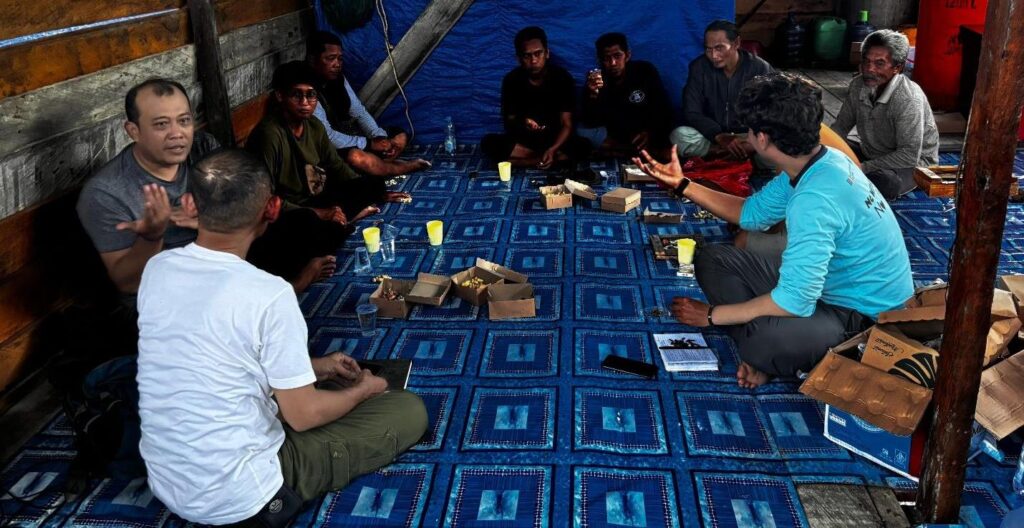
In 2024, the Ecosystem-Based Approaches/Nature-Based Solutions for Climate-Smart Sustainable Livelihoods in Mangrove Landscapes (NASCLIM) program was launched in four coastal villages in Bulungan Regency. One of the first activities was to invite pond farmers to collectively review their pond management methods through the Coastal Field School (CFS) initiative. Farmers then learned sustainable practices that support improved pond management, including the production and use of microorganisms native to the area. The farmers call this “MoL” in colloquial terms, which stands for mikroorganisme lokal, or “local microorganisms”.
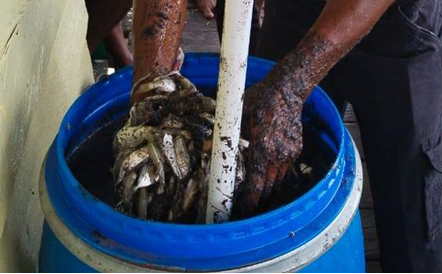
MoL is a solution rich in beneficial microbes that help accelerate the decomposition of organic matter, increase nutrient availability, and grow natural feed such as plankton in ponds. The MoL solution is made by mixing several organic materials available in the village, which are then fermented. Its application has been proven to improve water quality and pond soil fertility while reducing dependence on synthetic fertilizers and pesticides.
When the farmers first heard about MoL, many of them were skeptical about its benefits because of their unfamiliarity. However, this slowly turned into curiosity, especially when they saw one farmer who dared to try it and began to see positive results.
In Liagu Village, farmer Jony Lee noticed that the water in his ponds had returned to a greenish-brown color and that the shrimp were growing healthier after trying this method. “When I heard that a lot of my neighbor’s shrimp were sick and dying, and that mine survived, I concluded that it was because of the MoL I used,” he said. Jony now regularly uses MoL while continuing to consult with fisheries experts and academics to ensure that his practices are appropriate.
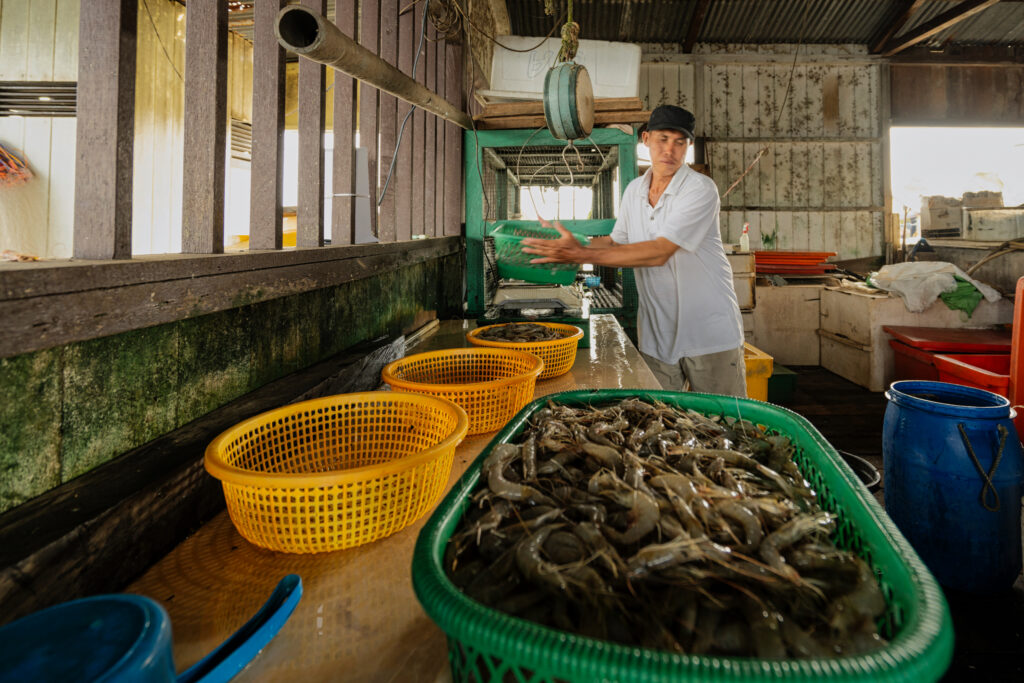
In Antal Hamlet, Salimbatu Village, the initiative came from Bohari, an experienced pond farmer. After attending the CFS Training of Trainers activity in Tanjung Selor, the capital of North Kalimantan, he ventured to experiment with making MoL from shrimp heads and molasses. The results were astonishing, with spotted shrimp suddenly appearing in quantities of up to 100 kilograms in a single cycle of pond yields.
“I couldn’t believe it myself. When I lifted the net and saw so many spotted shrimps, which I had never seen since I established the pond, I was incredibly happy,” he said. This addition became an unexpected blessing beyond the harvest of black tiger shrimp and milkfish that Bohari had been cultivating in his pond.
Studies show that the decline in pond productivity is generally due to the destruction of mangrove ecosystems in coastal areas. When mangroves are degraded, soil fertility and water quality in pond areas are further exacerbated. The NASCLIM program aims to raise awareness of mangrove benefits for the livelihoods of coastal communities in North and East Kalimantan.
With funding from the Government of Canada, NASCLIM also works with district government representatives in the two provinces to enhance policies that incentivize mangrove protection and rehabilitation efforts through a gender-responsive approach. The program works with the Ministry of Forestry of Indonesia to protect 1,800 hectares and rehabilitate 2,000 hectares of mangrove ecosystems across six villages in two provinces.
From this experience, an important lesson emerged: change requires initiative, awareness, innovation, and collaboration among all stakeholders. It is time for them to take action in supporting the utilization of local potential, strengthening nature-based solutions, and creating opportunities for shared learning for environmental sustainability and the welfare of coastal communities.
About NASCLIM
The Ecosystem-Based Approaches/Nature-based Solutions for Climate-smart Livelihoods in Mangrove Landscape (NASCLIM) is a collaborative program between the Global Green Growth Institute (GGGI) and Wetlands International Indonesia, designed to support the Government of Indonesia’s commitment to addressing mangrove deforestation. The program focuses on restoring degraded mangroves and protecting healthy mangroves in the Kayan–Sembakung Delta, North Kalimantan, and the Mahakam Delta, East Kalimantan, through an ecosystem-based approach.
NASCLIM is funded by the Government of Canada and coordinated with the Ministry of Forestry of Indonesia. The program also aims to strengthen policy-making at the national and subnational levels that supports long-term mangrove protection, and to serve as a replicable model at the national and global levels.
By :